John Dalton described atoms as simple indivisible particles. However, further discoveries led to the discovery of protons, neutrons and electrons which are sub-atomic particles.
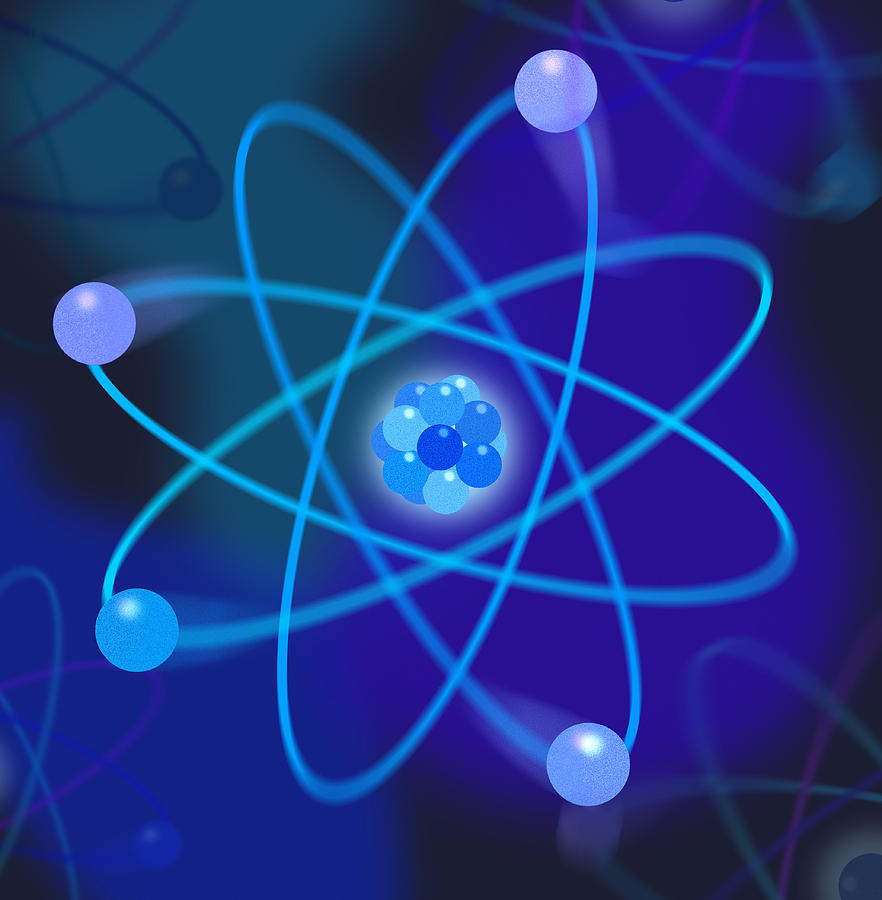
At the heart of matter are atoms, the basic building blocks. An atom consists of a nucleus, composed of protons and neutrons, surrounded by electrons orbiting in energy levels. Protons carry a positive charge, electrons a negative charge, while neutrons are neutral. The arrangement of these subatomic particles defines the unique properties of each element.
Discovery of protons
The proton, discovered by Ernest Rutherford in 1919, is a subatomic particle with a positive electric charge. Rutherford's gold foil experiment provided evidence for the existence of a positively charged particle in the nucleus, which was identified as the proton.It is a fundamental component of atomic nuclei, contributing to the stability of atoms. Protons have a mass of approximately 1 atomic mass unit. J.J Thompson discovered The charge to mass of proton which 1840 times more than that of electrons.
In 1886, Eugene Goldstein observed what he called "canal rays" in cathode ray tubes. This set a foundational work for the discovery of protons
Discovery of electrons
According to J.J. Thompson gases conducts electricity at low pressure and high potential difference.
The discovery of electrons is credited to J.J. Thomson, who conducted the cathode ray tube experiment in 1897. By passing electric currents through a vacuum tube, Thomson observed a stream of negatively charged particles, identifying them as electrons. This experiment provided crucial evidence for the existence of subatomic particles and challenged the prevailing atomic model.
R.A. Millikan's oil-drop experiment, conducted between 1909 and 1913, determined the charge of an electron and helped calculate its mass. Millikan suspended charged oil droplets in an electric field and carefully measured their motion. The results allowed him to calculate the charge of an electron, contributing significantly to the understanding of fundamental particle properties.
Discovery of neutrons
The discovery of neutrons is attributed to James Chadwick in 1932. In his experiments, Chadwick bombarded beryllium with alpha particles, leading to the emission of an uncharged particle. Through subsequent investigations, he identified this neutral particle as the neutron, a subatomic particle with mass of a proton but no electric charge. Chadwick's discovery of neutrons contributed significantly to the understanding of atomic structure and the stability of atomic nuclei.
Atomic models
- Dalton's Model (1803): Proposed by John Dalton, it envisioned atoms as indivisible, solid spheres with different masses for different elements.
- Thomson's Model (1897): J.J. Thomson's model introduced the idea of the "plum pudding," where electrons were embedded in a positively charged sphere, resembling raisins in a pudding.
- Rutherford's Model (1911): Ernest Rutherford's gold foil experiment led to the nuclear model, suggesting that atoms have a small, dense nucleus with positively charged protons, while electrons orbit around it at a distance.
- Bohr Model (1913): Proposed by Niels Bohr, it refined the Rutherford model by introducing quantized electron orbits, explaining the stability of atoms and the emission of spectral lines.
- Quantum Mechanical Model (1926 onward): Developed by Schrödinger and Heisenberg, this model describes electrons as existing within probability distributions called orbitals, rather than fixed orbits, incorporating the principles of wave mechanics.
Quantum numbers
- Principal Quantum Number (n): Denoted by the first quantum number (n), it represents the main energy level or shell of an electron. Higher values of n correspond to higher energy levels and larger orbitals.
The maximum possible number of electrons in a shell numbered 'n' is 2n² and the total number of orbitals is given by n².
| Principal Quantum Number (n) | Maximum Number of Electrons | Maximum Number of Orbitals |
|---|---|---|
| K(1) | 2 | 1 (s) |
| L(2) | 8 | 4 (s, p) |
| M(3) | 18 | 9 (s, p, d) |
| N(4) | 32 | 16 (s, p, d, f) |
- Azimuthal Quantum Number (l): Denoted by the second quantum number (l), it defines the shape of the orbital. The values of l range from 0 to (n-1) and determine the type of subshell (s, p, d, f). For example, l=0 corresponds to an s orbital, l=1 to a p orbital, and so on.
| Orbital | Shape | Energy Level | Maximum Electrons |
|---|---|---|---|
| s | Spherical | 1 | 2 |
| p | Dumbbell | 2 | 6 |
| d | Double Dumbbell | 3 | 10 |
| f | Complex | 4 | 14 |
- Magnetic Quantum Number (ml): Denoted by the third quantum number (ml), it specifies the orientation of an orbital in space and number of orbitals in each energy sub-level. The values of ml range from -l to +l, including zero. For instance, a p orbital has three possible orientations along the x, y, and z axes.
For example, for l = 0, the value of m is 1 which corresponds to 1 s orbital
For l = 1, the value of m = -1, 0, +1 which corresponds to 3 p-orbitals
for l = 2, the value of m = -2, -1, 0, +1, +2 which corresponds to the five d-orbitals
for l = 3, the value of m = -3, -2, -1, 0, +1, +2, +3 which corresponds to the 7 f-orbitals - Spin Quantum Number (ms): Denoted by the fourth quantum number (ms), it describes the intrinsic spin of an electron. Electrons can have a spin of +½ or -½. These values correspond to the opposing spins of electrons within an orbital.
Rules of filling orbitals
- Aufbau Principle: Electrons fill the lowest energy orbitals first before moving to higher energy ones.
- Pauli Exclusion Principle: No two electrons in an atom can have the same set of four quantum numbers, particularly the spin quantum number, with one being +½ and the other -½.
- Hund's Rule: Electrons occupy orbitals of the same energy level singly and with parallel spins before pairing up. This maximizes the total electron spin and stabilizes the atom.
| Atomic Number | Element | Electron Configuration |
|---|---|---|
| 1 | H | 1s¹ |
| 2 | He | 1s² |
| 3 | Li | 1s² 2s¹ |
| 4 | Be | 1s² 2s² |
| 5 | B | 1s² 2s² 2p¹ |
| 6 | C | 1s² 2s² 2p² |
| 7 | N | 1s² 2s² 2p³ |
| 8 | O | 1s² 2s² 2p⁴ |
| 9 | F | 1s² 2s² 2p⁵ |
| 10 | Ne | 1s² 2s² 2p⁶ |
| 11 | Na | 1s² 2s² 2p⁶ 3s¹ |
| 12 | Mg | 1s² 2s² 2p⁶ 3s² |
| 13 | Al | 1s² 2s² 2p⁶ 3s² 3p¹ |
| 14 | Si | 1s² 2s² 2p⁶ 3s² 3p² |
| 15 | P | 1s² 2s² 2p⁶ 3s² 3p³ |
| 16 | S | 1s² 2s² 2p⁶ 3s² 3p⁴ |
| 17 | Cl | 1s² 2s² 2p⁶ 3s² 3p⁵ |
| 18 | Ar | 1s² 2s² 2p⁶ 3s² 3p⁶ |
| 19 | K | 1s² 2s² 2p⁶ 3s² 3p⁶ 4s¹ |
| 20 | Ca | 1s² 2s² 2p⁶ 3s² 3p⁶ 4s² |
| 21 | Sc | 1s² 2s² 2p⁶ 3s² 3p⁶ 4s² 3d¹ |
| 22 | Ti | 1s² 2s² 2p⁶ 3s² 3p⁶ 4s² 3d² |
| 23 | V | 1s² 2s² 2p⁶ 3s² 3p⁶ 4s² 3d³ |
| 24 | Cr | 1s² 2s² 2p⁶ 3s² 3p⁶ 4s¹ 3d⁵ |
| 25 | Mn | 1s² 2s² 2p⁶ 3s² 3p⁶ 4s² 3d⁵ |
| 26 | Fe | 1s² 2s² 2p⁶ 3s² 3p⁶ 4s² 3d⁶ |
| 27 | Co | 1s² 2s² 2p⁶ 3s² 3p⁶ 4s² 3d⁷ |
| 28 | Ni | 1s² 2s² 2p⁶ 3s² 3p⁶ 4s² 3d⁸ |
| 29 | Cu | 1s² 2s² 2p⁶ 3s² 3p⁶ 4s¹ 3d¹⁰ |
| 30 | Zn | 1s² 2s² 2p⁶ 3s² 3p⁶ 4s² 3d¹⁰ |