Force and Friction III
Friction on an Inclined plane

The frictional force experienced by a body placed on an inclined plane as shown in the diagram below is:

/images/R.png

$$\text{frictional force} = μR$$ $$\text{Normal reaction} = mgcosθ $$ $$\text{frictional force} = μMgcosθ $$ $$\text{the force against against friction} $$ $$ f = mgsinθ $$ $$\text {Net force, f} = mgsinθ - μmgcosθ $$ $$\text{Net force, f} = mgsinθ - F $$ $$ where,\text{ F = Frictional force }$$ $$\text{To get the Value for acceleration} $$ $$ F = ma $$ $$ ma =mg(sinθ - μcosθ) $$ $$\text{acceleration, a} = g(sinθ - μcosθ) $$ Example 1 : A concrete block of mass 25kg is placed on a wooden plank inclined at an angle of 60° to the horizontal. Calculate the force parallel to the inclined plane that will keep the block at rest if the coefficient of friction between the block and the plank is 0.45

Solution
$$ \text{The frictional force is given by} $$ $$ F = μMgcosθ $$ $$ F = 0.45 × 25 × 10 × cos 60° $$ $$ F = 56.25N $$

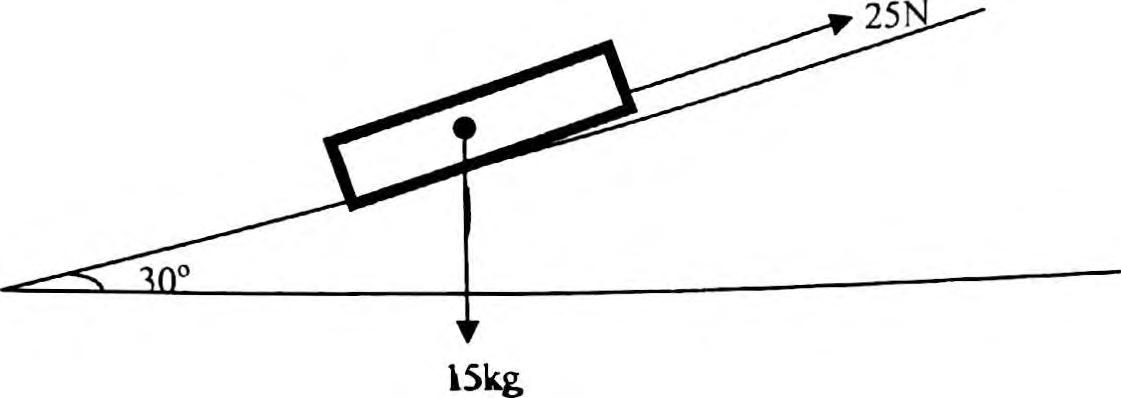
Example 2: The diagram above shows a body resting on an inclined plane. If the body slides down the plane, what will be its acceleration? (g = 10m/s²) (WAEC)


Solution
$$ F = 25N $$ $$ m = 15kg $$ $$ θ = 30° $$ $$\text {Net force, f} = mgsinθ - F $$ $$ f = 15 × 10 × sin 30° - 25 $$ $$ f = 75 - 25 = 50N $$ $$\text{But, net force, f} = ma $$ $$ a = \frac{f}{m} $$ $$ a = \frac{50}{15} = 3.33m/s² $$

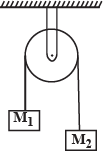
Example 3 : Two masses M1 = 5kg and M2 = 10kg are connected at the ends of an inextensible string passing over a frictionless pulley as shown. When the masses are released, then the acceleration of the masses will be:


Solution
$$\text{for }{m_1} $$ $$\text{Tension in the string} = mg + ma $$ $$ T = ma + mg $$ $$ T = {5}a + {5}g$$
$$\text{For }{M_2} $$ $$\text{Tension in the string} = mg - ma $$ $$ T = {10}g - {10}a $$ $$ \text{equating both equations} $$ $$ 5a + 5g = 10g - 10a $$ $$ 5a + 10a = 10g - 5g $$ $$ 15a = 5g $$ $$ a = \frac{5g}{15} = \frac{g}{3} $$

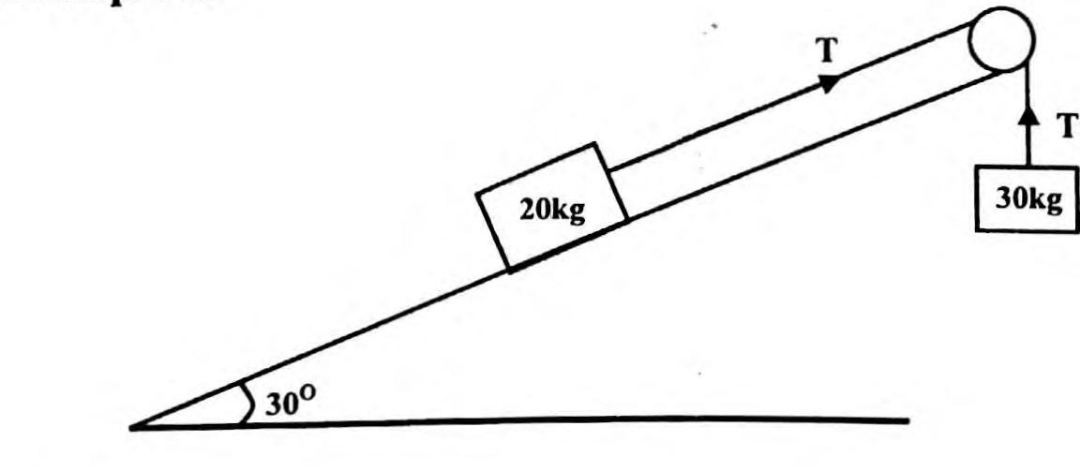
Example 4 : The acceleration of the system shown below is? (JAMB)
Solution
$$\text{For the 20kg mass at θ} $$ $$ T = ma + mgsinθ $$ $$ T = 20a + 20 × 10 × sin30 $$ $$ T = 20a + 100 $$
$$\text{for the 30kg mass} $$ $$ T = mg - ma $$ $$ T = 30 × 10 - 30a $$ $$ T = 300 - 30a $$ $$\text{equating both} $$ $$20a + 100 = 300 - 30a $$ $$ 20a + 30a = 300 - 100 $$ $$ 50a = 200 $$ $$ a = \frac{200}{50} $$ $$ a = 4m/s² $$

Example 5 : A motorcycle of mass 100kg moves round in a circle of radius 10m with a velocity of 5m/s. Find the coefficient of friction between the road and tyres.

Solution
$$ mass = 100kg $$ $$ radius = 10m $$ $$ v = 5m/s $$ $$\text{frictional force} = μR$$ $$\text{But, F} = \frac{mv²}{r} $$ $$ F = \frac{100 × 5²}{10} $$ $$ F = 250N $$ $$ R = mg $$ $$R = 100 × 10 = 1000N $$ $$ μ = \frac{F}{R} $$ $$ μ = \frac{250}{1000} = 0.25 $$
Advantages of friction
  1. Friction enables us to walk, run, and balance by providing traction and stability.
  2. Friction generates heat and fire when two surfaces rub against each other.
  3. Friction enables us to control the motion of objects by slowing them down or stopping them.
  4. Friction is important in sports and recreational activities that involve sliding, rolling, or bouncing.
  5. Friction is essential in braking systems that use friction to stop vehicles.
  6. Friction allows us to write on paper with a pencil or a pen by creating sliding friction.
  7. Friction can be used to generate sparks or fire by rubbing two objects together.
Disadvantages of friction
  1. Friction produces heat, which results in energy waste
  2. Friction causes wear and tear of machines
  3. Friction causes moving objects to stop
  4. Friction decreases the life expectancy of moving parts of vehicles
  5. Friction slows down the speed of moving objects
  6. Friction requires extra energy to overcome
  7. Friction generates noise in machines
Ways to reduce friction
  1. Make surfaces smooth by grinding: This method reduces the interlocking of the microscopic asperities on the sliding surfaces, which are the main cause of friction.
  2. Use lubricants: Lubricants are substances that create a thin layer between the sliding surfaces, reducing the contact and the friction. Examples of lubricants are oil, grease, and wax.
  3. Use a streamlined shape: A streamlined shape reduces the drag force caused by the fluid friction when an object moves through a liquid or a gas. Examples of streamlined shapes are dolphins, fish, and airplanes.
  4. Reduce the normal force: The normal force is the force that acts perpendicular to the sliding plane, and it is directly proportional to the friction. By reducing the weight or the pressure on the object, the normal force and the friction can be reduced.
  5. Use rolling friction instead of sliding friction: Rolling friction is the friction that occurs when an object rolls over a surface, and it is usually much lower than sliding friction. By using ball bearings, wheels, or rollers, the sliding friction can be replaced by rolling friction.
Summary