Electric charges
Electric charges II
The overall function of the gold leaf electroscope is to detect and quantify electric charge. When a charged object is brought close to the metal rod, it transfers some of its charge to the gold leaf, causing it to repel due to like charges. The extent of deflection can be measured on the scale, providing information about the magnitude of the charge.
The gold leaf electroscope is a simple and effective tool for demonstrating the presence and magnitude of electric charge.
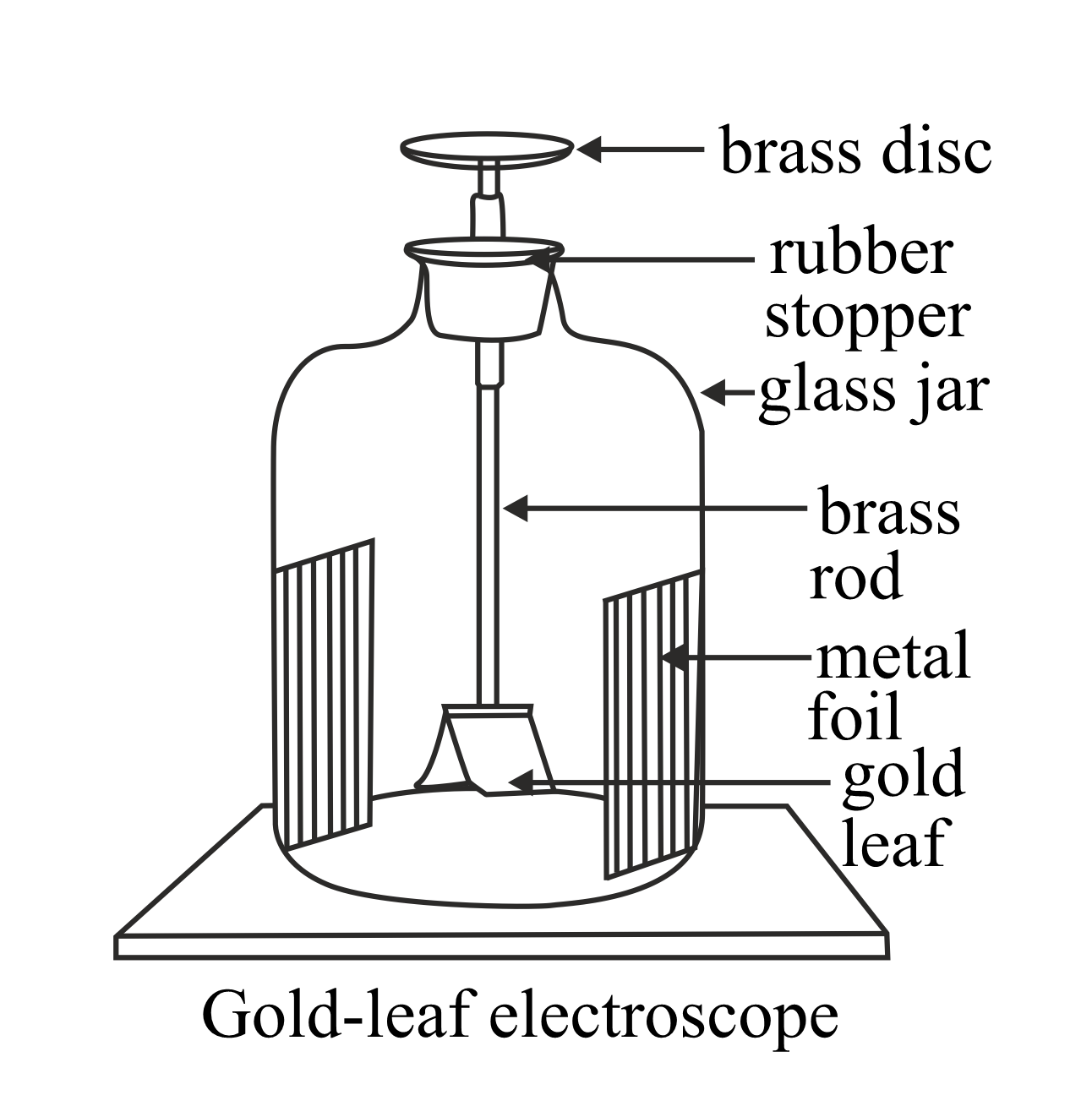
Functions of labelled parts
- Brass Disc:
- Provides a stable base for the electroscope.
- Acts as a conductor to distribute charge evenly.
- Metal Foil:
- Forms the thin, lightweight gold leaf.
- Serves as an indicator by deflecting in response to electric charge.
- Brass Rod:
- Conducts electric charge from the object being tested to the gold leaf.
- Glass Jar:
- Provides an insulating barrier to prevent charge leakage.
- Encases the internal components, protecting them from external influences.
- Rubber Stopper:
- Seals the glass jar, maintaining the integrity of the internal environment.
- Prevents air currents that could affect the gold leaf's movement.
- Gold Leaf:
- Suspended to serve as a visual indicator of electric charge presence.
- Deflects in response to electric charges due to repulsion between like charges.
Making a simple electroscope
Charging the electroscope
- By contact
-
Choose a Charged Object:
- Select a charged object, such as a charged rod or balloon.
-
Contact the Electroscope:
- Bring the charged object into direct contact with the metal rod of the electroscope.
- Electrons from the charged object transfer to the metal rod, charging the electroscope.
-
Observe Gold Leaf Deflection:
- Due to the transferred charge, the gold leaf, being lightweight and negatively charged, will be repelled and deflect.
- The degree of deflection indicates the magnitude of the charge introduced.
-
Positive Charge:
- When a positively charged object contacts the electroscope, electrons are transferred from the electroscope to the positively charged object.
- The electroscope is left with a deficiency of electrons, resulting in a net positive charge.
-
Negative Charge:
- When a negatively charged object contacts the electroscope, electrons transfer from the charged object to the electroscope.
- The electroscope now has an excess of electrons, resulting in a net negative charge.
-
Positive Charge:
- When the electroscope acquires a positive charge, the gold leaf, being negatively charged, will be repelled and deflect.
- The extent of deflection indicates the magnitude of the positive charge.
-
Negative Charge:
- When the electroscope acquires a negative charge, the gold leaf, being negatively charged as well, will also be repelled and deflect.
- The degree of deflection indicates the magnitude of the negative charge.
- By electrostatic induction
-
Ground the Electroscope:
- Touch the metal case or rod of the electroscope to a grounded object to neutralize any existing charge.
-
Bring a Charged Object Near:
- Bring a charged object close to, but not touching, the metal rod of the electroscope.
- Electrons in the metal rod are repelled, and some move to the side of the electroscope closest to the charged object, inducing a charge separation.
-
Ground the Electroscope Again:
- While the charged object is still nearby, touch the metal case or rod of the electroscope to a grounded object again.
- The induced charge redistributes, leaving the electroscope with a net charge even after removing the charged object.
-
Observe Gold Leaf Deflection:
- Due to the induced charge, the gold leaf deflects, and the extent of deflection indicates the magnitude of the induced charge.
-
Positive Charge:
- When a positively charged object is brought near the electroscope, electrons in the metal rod are attracted towards the positively charged object.
- The gold leaf, being negatively charged, will be repelled and deflect.
- The degree of deflection indicates the magnitude of the induced positive charge.
-
Negative Charge:
- When a negatively charged object is brought near the electroscope, electrons in the metal rod are repelled by the negatively charged object.
- The gold leaf, being negatively charged as well, will still be repelled and deflect, but the deflection may be less compared to a positive charge.
- The degree of deflection indicates the magnitude of the induced negative charge.
Procedures involved
Acquiring Positive and Negative Charges:
Behavior of the Gold Leaf:
Electrostatic induction is the act of charging a neutral body by placing a charged body near it without any contact between the two.
Charging the Gold Leaf Electroscope by Electrostatic Induction:
Behavior of the Gold Leaf to a Positively and Negatively Charged Body: