Vectors
Vectors are physical quantities that possess
both magnitude and direction. They give us information
about the direction of the quantity. Examples are displacement, force, acceleration, velocity, weight, gravity,
pressure, etc. While Scalers are physical quantities that have numerical values only. Examples of scalers
include: mass, work, distance, current, distance, speed, energy, etc.
Differences between Scalers and vectors
| Scalars |
Vectors |
| Possess magnitude alone |
Quantity with magnitude and direction |
| They possess single values |
They possess ordered set of values (coordinates) |
| They can be resolved by simple arithmetic |
They require more than simple arithmetic to be resolved |
Examples include work, mass,
distance, length,
temperature (e.g., 25°C) |
Examples include acceleration, force, gravity, velocity (e.g., 30 m/s North) |
Represented as points on a
number line |
Represented as arrows with length and direction |
| It is Shown graphically on a single axis |
It is plotted on coordinate planes |
Vector representation
Vectors are represented using arrowheads or coordinate lines. The arrowheads or coordinate lines give a
pictorial explanation of the direction. For example, if a man moves 10km North, the vector is represented by a
straight line with a arrowhead which points to the North cardinal point.
Resolution of vectors
Two or more vectors can be resolved to produce a single vector that has the same magnitude and direction as the
vectors acting together. This single vector is called a resultant vector. A resultant vector(R) is a
single
vector that has the same magnitude and direction as two or more vectors acting together.
R = A + B
There are four scenarios when resolving vectors and two laws that govern the resolution of vectors.
- Addition of vectors that lie in a single plane moving in the same direction
The resultant vector of two or more vectors acting in the same plane and moving in the same direction is the
sum of the vectors acting in that plane. They are given positive components.
:. R = (A) + (B)
Example 1 :
Find the resultant of the vectors 4i + 3j -5k and 8i + 6j - 10k
Solution
The direction ratios of the two vectors are in equal proportion and hence the two vectors are in the same
direction.
The following resultant vector formula can be used here.
R = A + B
= (4i + 3j - 5k) + (8i + 6j - 10k)
= (4i + 8i) + (3j + 6j) + (-5k + (-10k))
= 12i + 9j - 15k
Example 2: Two parallel coplanar forces 5N and 7N all acts in the same plane in the same
direction. Calculate the resultant force.
Solution
Since the two forces act in the same direction. The resultant force is the sum of the two individual
vectors
R = A + B
R = 5 + 7
R = 12N
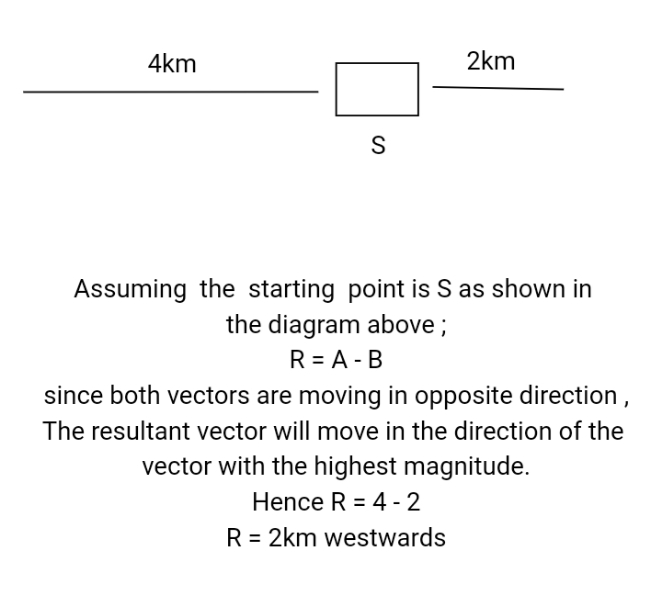
- Adding of vectors that lie on the same plane moving in opposite directions
The resolution of vectors that lie in opposite directions on a single plane is given by :
R = A + (-B)
R = A - B
Example 1 : Suppose a boy walks a distance of 2km eastwards to a point A and then walks another
distance
4km westwards, Calculate his displacement from the starting point.
Solution