Example 1
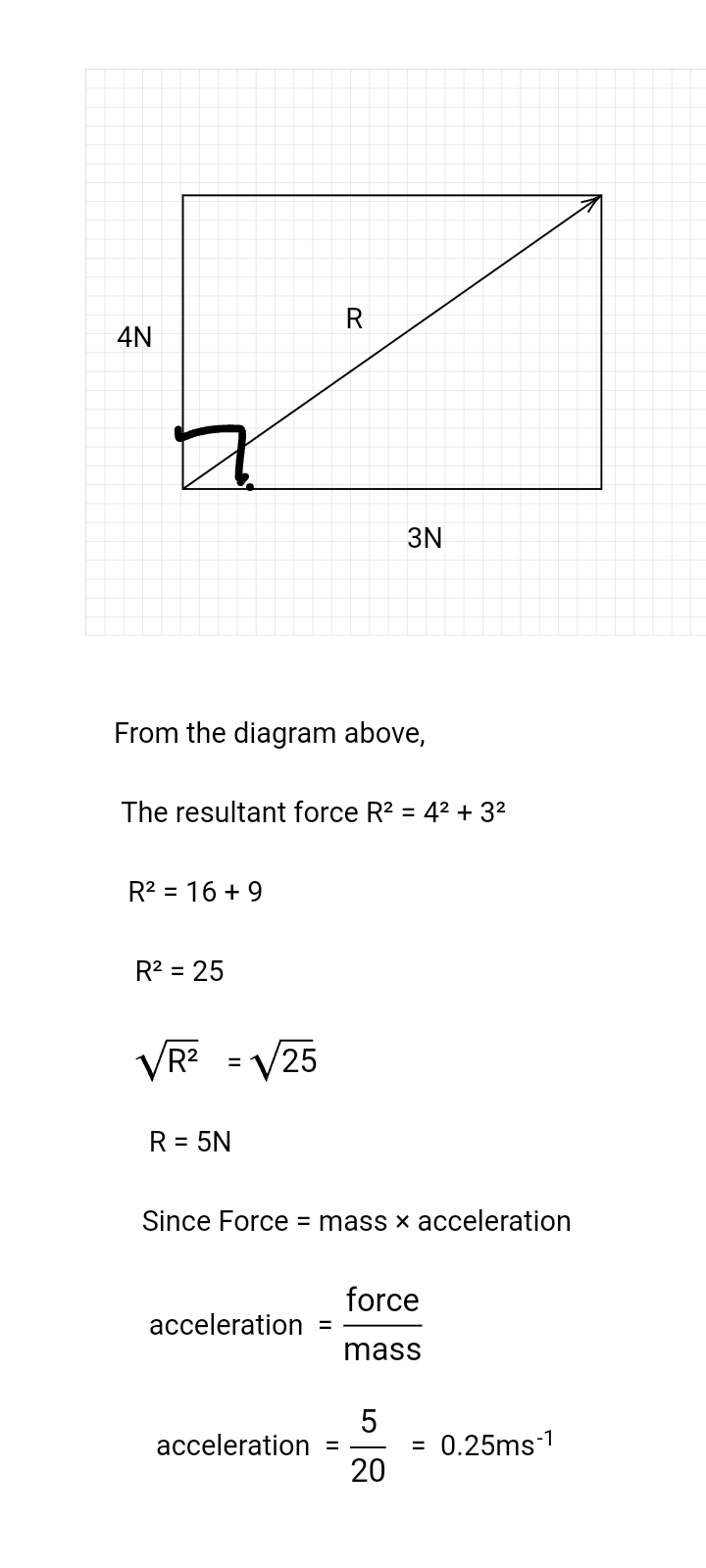
A body of mass 20kg is set in motion by two forces 3N and 4N acting at right angles to each other. Determine
the
magnitude of the acceleration.
Solution
Mass = 20kg; acceleration = ?
To solve for acceleration we must first find the resultant force which is equal to the two forces
Example 2
Two forces of magnitude 7N and 5N act on a particle at an angle θ to each other, θ
can have any value. The minimum magnitude of the resultant force is
Solution
Magnitude of the resultant will be minimum when θ = 180°
and its value is given as:
R = 7N - 5N = 2N
Example 3
A lorry travels 10km northwards, 4km eastwards, 6km southwards and 4km westwards to arrive at a point T. what
is
the total displacement.
Solution
The direction of the vector is determined by the unit with the highest magnitude.
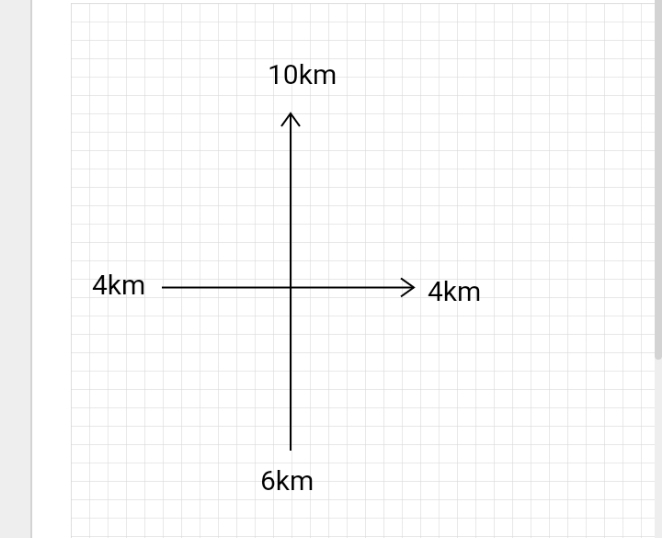
From North to South, they all lie in the same plane but in opposite direction. Hence the
vector
resolution
= 10 - 6
= 4km
From west to East
vector resolution = 4 - 4
= 0
Hence the displacement of the boy
= 4km North
Example 4
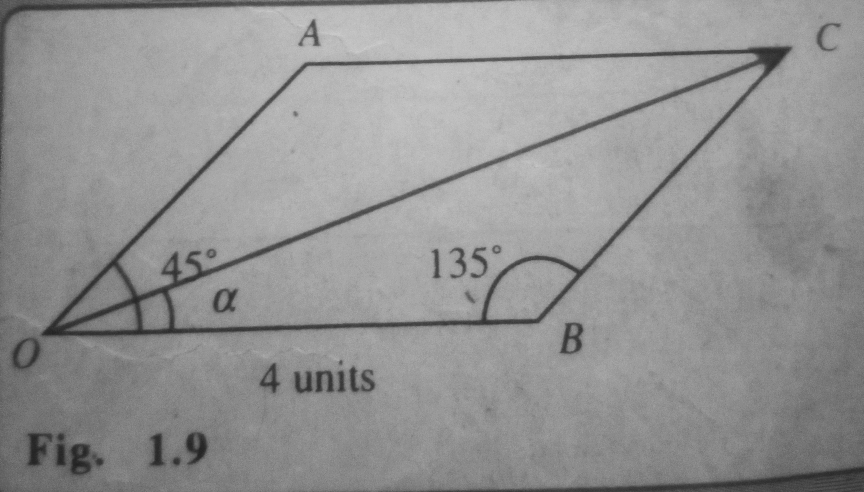
Find the resultant of two vectors of 3 units and 4 units acting at an angle of 45⁰ with each other.
Solution
$$ R = \sqrt{P² + Q² + 2PQcos\theta} $$
$$ R = \sqrt{3² + 4² + 2(3)(4)cos45°} $$
$$ R = \sqrt{9 + 16 + 16.97} $$
$$ R = \sqrt{41.97} $$
$$ R = 6.48 units $$
$$ \alpha = tan^{-1}(\frac{Psin\theta}{Q + Pcos\theta}) $$
$$ \alpha = tan^{-1}(\frac{3sin45}{4 + 3cos45}) $$
$$ \alpha = 19.11° $$
Example 5
An object is acted upon by two forces of 5N and 12N. Calculate the resultant of the forces if
- The forces act perpendicular to each
other
- The forces act at an angle of 40⁰ to each other
- The forces act at an angle of 120° to each other
Solution
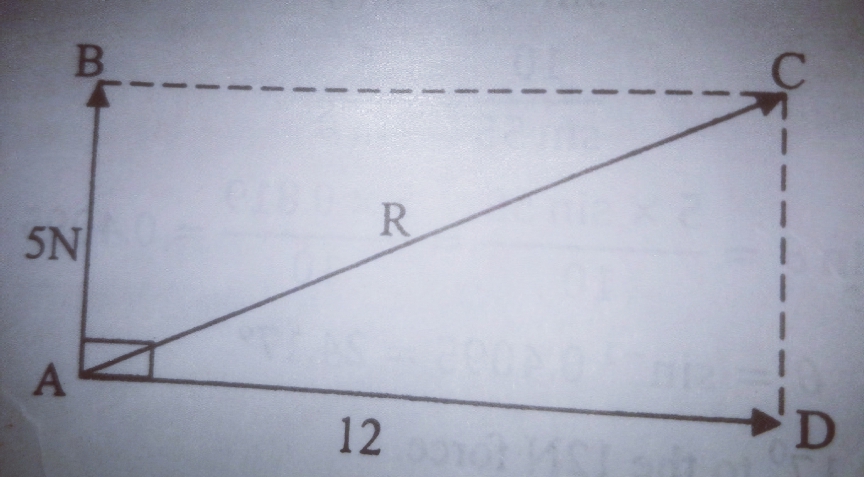
The resultant, R is given as:
$$ R = \sqrt{P² + Q²} $$
$$ R = \sqrt{5² + 12²} $$
$$ R = \sqrt{169} $$
$$ R = 13N $$
The direction is given as:
$$ \alpha = tan^{-1}(\frac{P}{Q}) $$
$$ \alpha = tan^{-1}(\frac{5}{12}) $$
$$ \alpha = 22.61° $$
ii. When it is inclined at an angle of 40⁰
The resultant, R is given as:
$$ R = \sqrt{5² + 12² + 2(5)(12)cos40°} $$
$$ R = \sqrt{25 + 144 + 91.93} $$
$$ R = 16.15N $$
The direction is given as:
$$ \alpha = tan^{-1}(\frac{5sin40}{12 + 5cos40}) $$
$$ \alpha = 11.48° $$
ii. When it is inclined at an angle of 120⁰
The resultant, R is given as:
$$ R = \sqrt{5² + 12² + 2(5)(12)cos120°} $$
$$ R = \sqrt{25 + 144 - 60} $$
$$ R = 10.44N $$
The direction is given as:
$$ \alpha = tan^{-1}(\frac{5sin120}{12 + 5cos120}) $$
$$ \alpha = 24.50° $$
Example 6
An aircraft attempts to fly due North at 100km/h. If the wind blows against it from east to west at 60km/h. its
resultant velocity is?(Jamb)
Solution
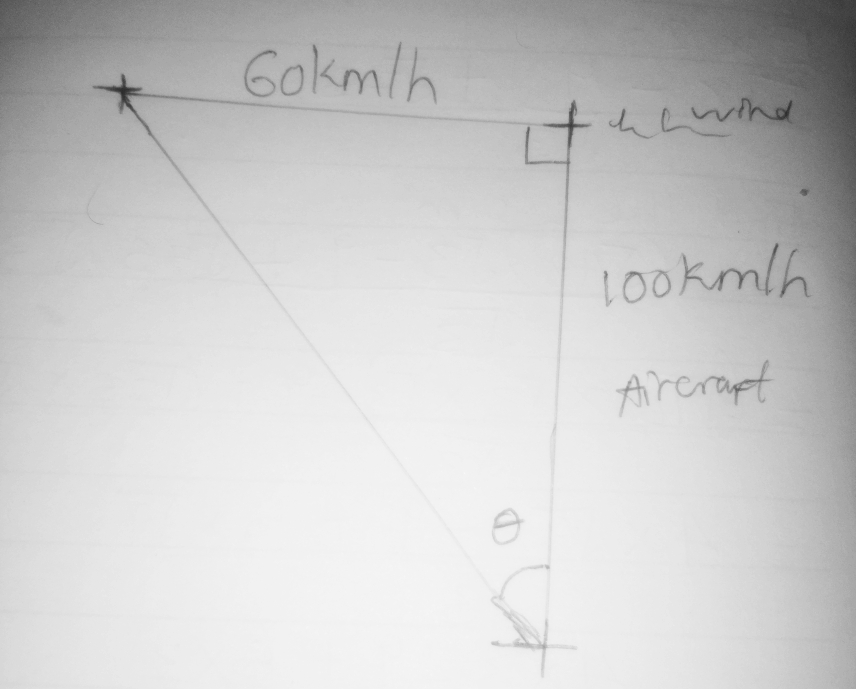
The resultant, R is given by:
$$ R = \sqrt{60² + 100²} $$
$$ R = \sqrt{3600 + 10,000} $$
$$ R = \sqrt{13600} $$
$$ R ≈ 117km $$
The direction \( \alpha \) is given by:
$$ \alpha = tan^{-1}(\frac{P}{Q}) $$
$$ \alpha = tan^{-1}(\frac{60}{100}) $$
$$ \alpha = tan^{-1}(0.6) $$
$$ \alpha ≈ 30.96° $$
$$ \alpha ≈ 31° $$
$$ R = 117km, \alpha = N31°W $$
Example 7
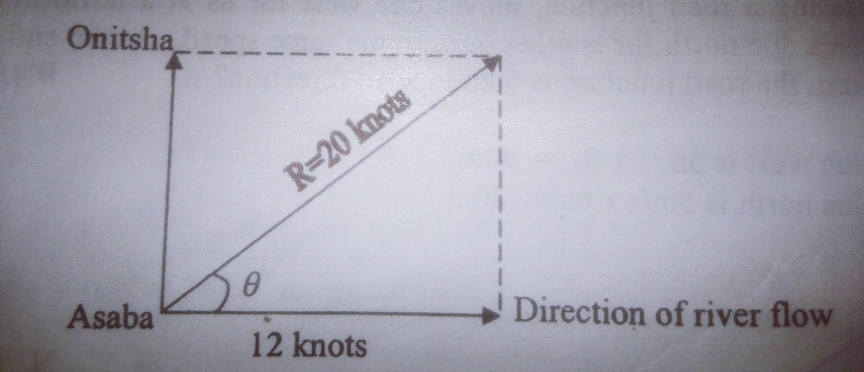
A tug boat is travelling from Asaba to Onitsha across the River Niger with a resultant velocity of
20knots. If the river flows at 12 knots, the direction of motion of the boat relative to the direction of water
flow is?(JAMB)
Solution
The direction \( \theta \) is given by:
$$ Cos \theta = \frac{adj}{hyp} $$
$$ cos \theta = \frac{12}{20} $$
$$ \theta = cos^{-1}(0.6) $$
$$ \theta = 53.13° $$
Example 8
Two forces whose resultant is 100N are at right angles to each other. If one of them makes an angle of 30° with the resultant, determine its magnitude (JAMB)
Solution
let the unknown force be x
From trigonometry,
$$ cos 30 = \frac{x}{100} $$
$$ x = 100cos 30 $$
$$ x = 86.6N $$