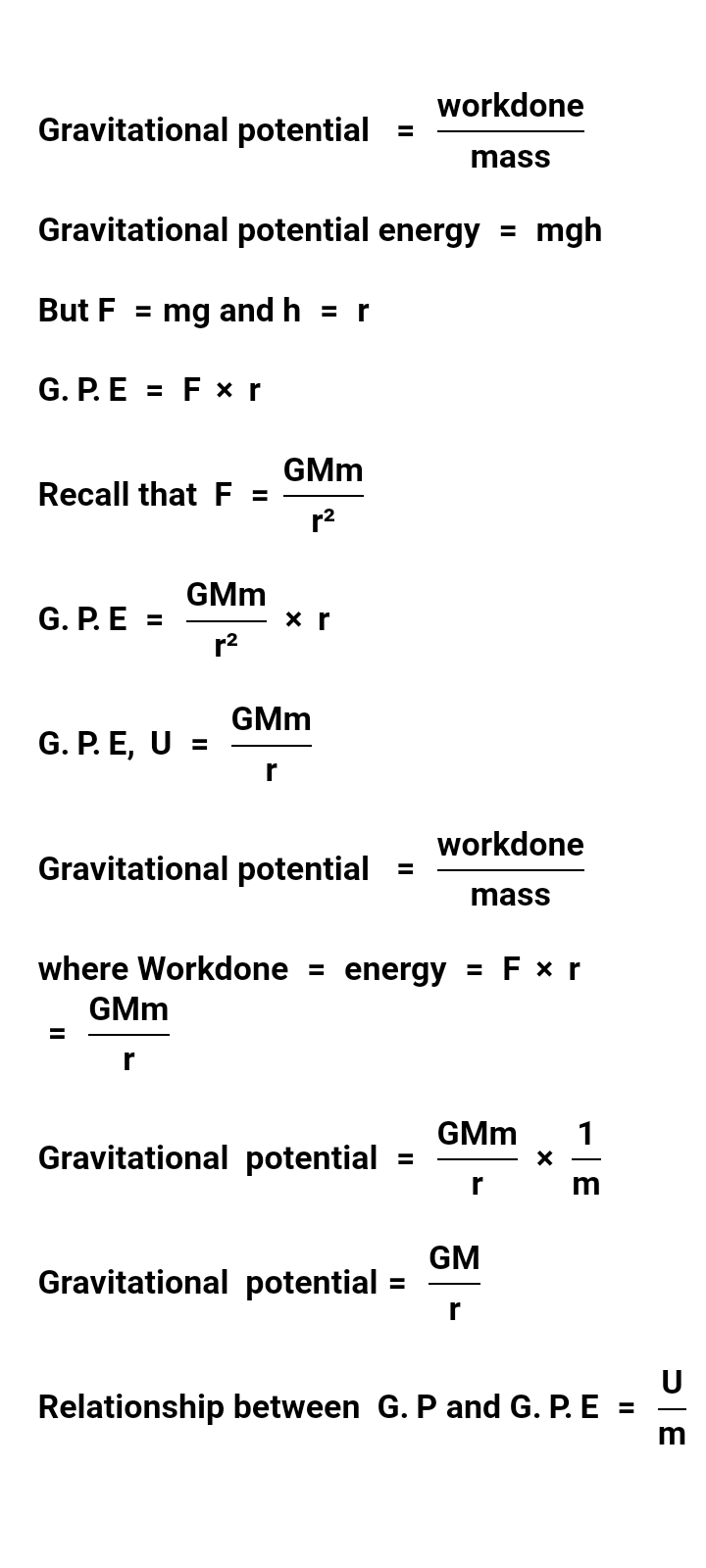
Gravitational potential at a point can be defined as the workdone required to take a unit mass from infinity
to that point.
In classical mechanics, the gravitational potential at a point in space is equal to the work (energy
transferred) per unit mass that would be needed to move an object to that point from a fixed reference point.
Thus, the gravitational potential is the work done per unit mass by some externally applied force to bring a
mass from zero potential to infinity. The formula is given by;
V = -GM/r
Here V is the Gravitational potential due to gravity, M is the mass of the source and r is the distance between
the source and unit mass.
Gravitational potential energy
Gravitational Potential Energy (G.P.E) is defined as the energy stored in an object due to its height above
the earth. The amount of gravitational potential energy depends on the mass and height of an object.
G.P.E = U = mgh
Relationship between G.P and G.P.E
Examples
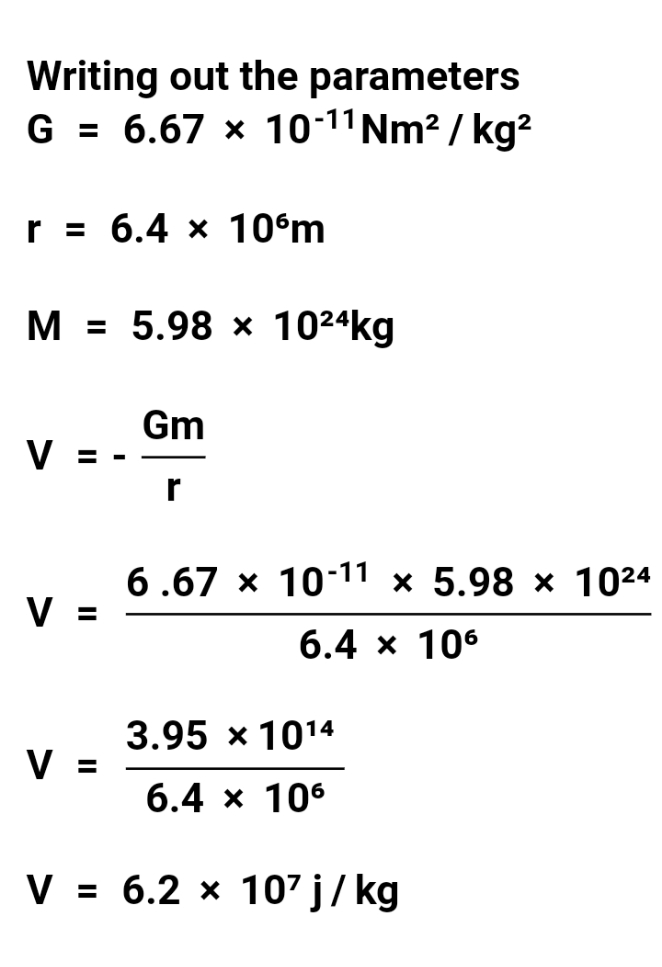
Example 1: What is the gravitational potential at a point on the surface of the earth if G = 6.67 ×
10-11Nm²kg-2 and the radius and mass of the earth are respectively 6.4 × 10⁶m and 5.98 ×
10²⁴kg?
Solution
Example 2: Find the gravitational potential energy of 2.5 kg mass kept at a height of 15 m above the
ground. The force of gravity on mass 1 kg is 10 N.
Solution
G.P.E = U
U = mgh
where m = 2.5kg
h = 15m
But g = force/mass
:. g = 10m/s²
U = 2.5 × 10 × 15
G.P.E = 3.75 × 10²J
use e as exponential on the calculator to solve questions having exponential values....G is an inbuilt
function = 6.67 x 10 -¹¹Nm²/kg², g = 10m/s²