Gravitational field can be defined as the region or space in which a unit mass in relation to other bodies will be
influenced by gravitational force.
The gravitational force per unit mass that would be exerted on a small test mass at that point is defined as the
gravitational field. It is a vector field, and points in the direction of the force that a small test mass would
feel at that point.
Universal law of gravitation
Newton’s Law of Universal Gravitation states that every particle attracts every other particle in the universe
with a force directly proportional to the product of the masses and inversely proportional to the square of the
distance between them.
The formula for gravitational force is given by :
where G = 6.67 x 10⁻¹¹Nm²/kg²
Calculations
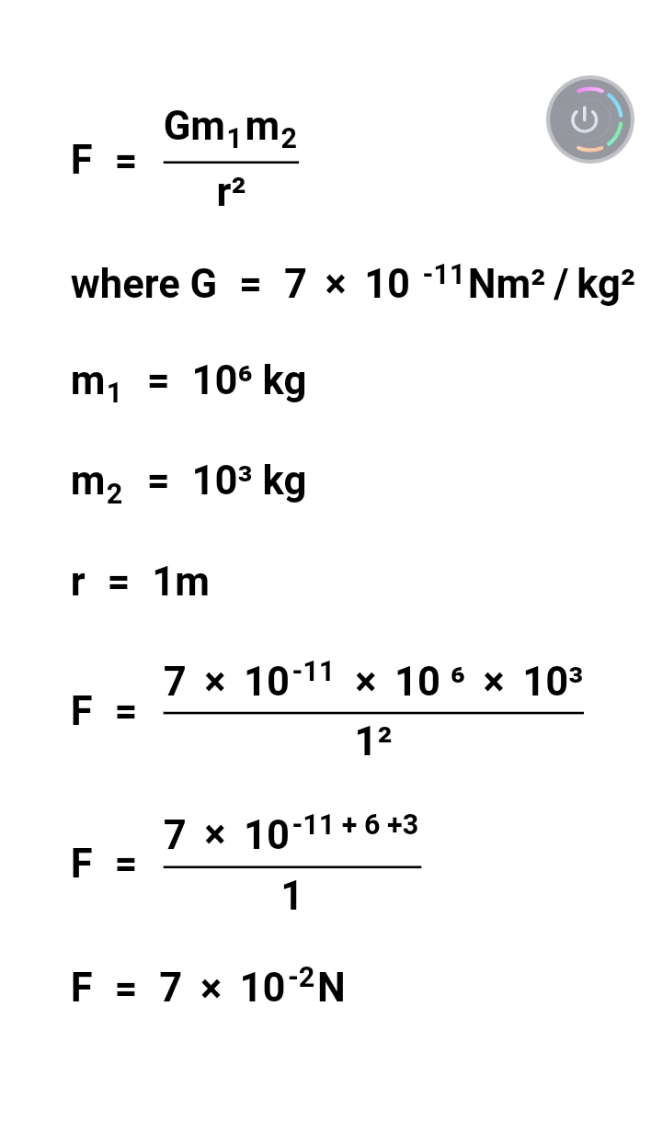
Example 1: Given that the gravitational constant is 7 × 10-11Nm²Kg-2
, what is the force of the attraction between 10⁶kg mass of lead hanging one meter away from a 10³kg mass of iron?
WAEC
Solution
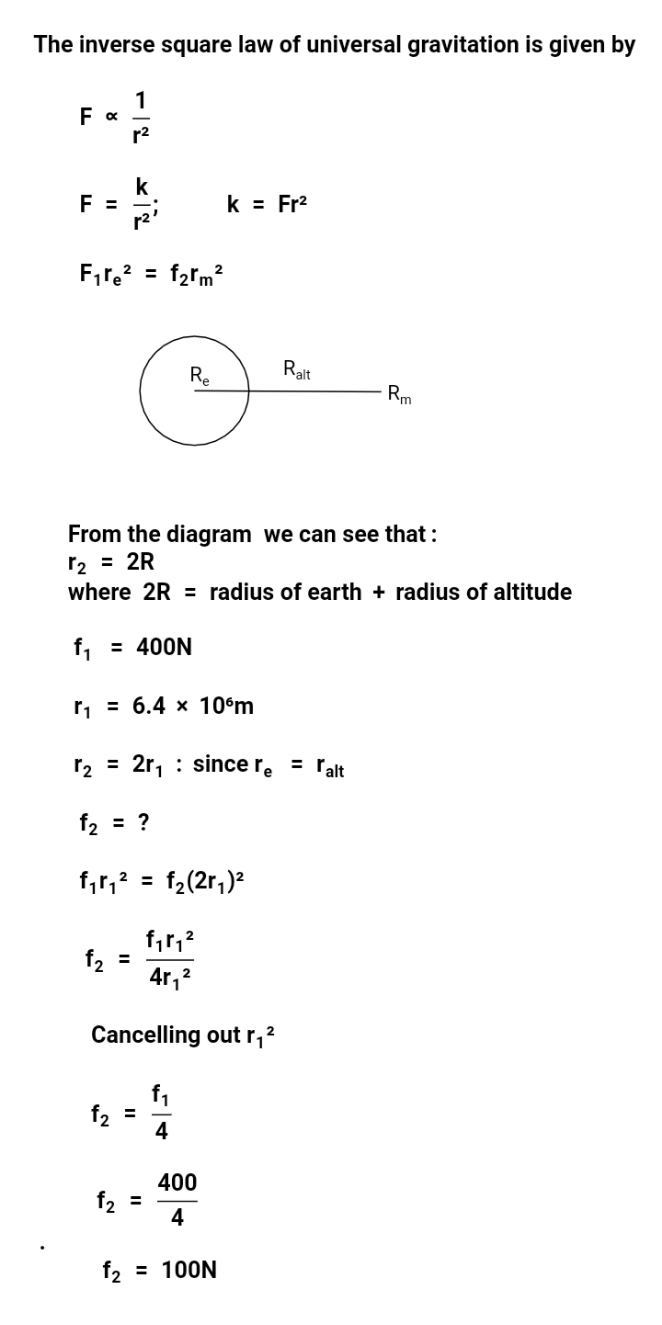
Example 2: A missile weighing 400N on the earth's surface is shot into the atmosphere to an altitude of
6.40 × 10⁶m. Taking the earth as a sphere of radius 6.4 × 10⁶m and assuming inverse square law of universal
gravitation.What will be the weight of the missile at the altitude? WAEC
Solution
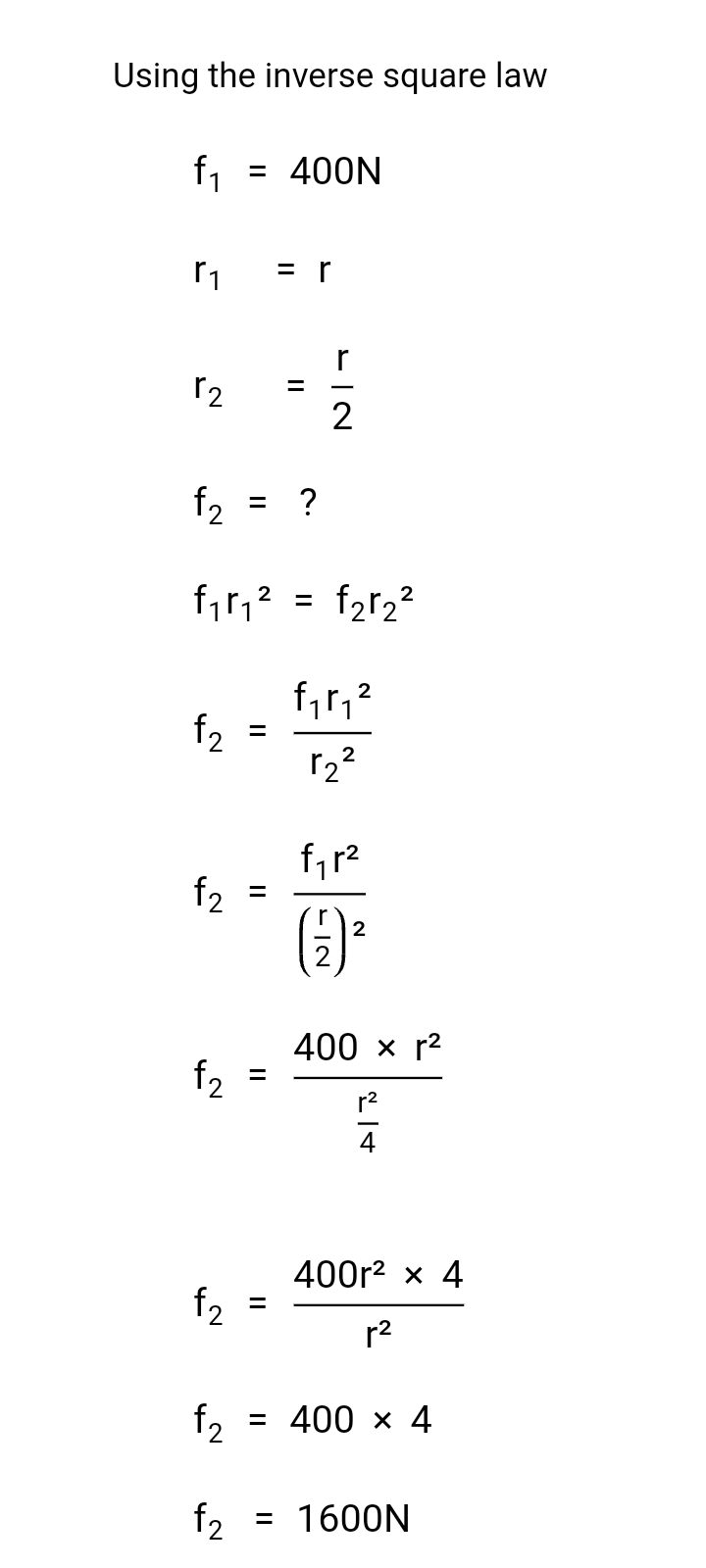
Example 3: A force of 400N acts between two objects at a certain distance apart. The value of the force
when the distance is halved?