Relative motion is the movement of a body in relation to another body.
Relative motion refers to the concept of how the position and velocity of an object are described
with respect to another object. It is a fundamental principle in physics and is often used to analyze the motion
of objects in different frames of reference. When we study relative motion, we consider the movement of one
object relative to another, rather than looking at their absolute positions and velocities.
For example, if you are sitting in a moving car, your relative motion with respect to the car is
different from your relative motion with respect to objects outside the car, like trees or buildings. This
concept is essential in understanding concepts such as velocity, acceleration, and the laws of motion, as it
allows us to describe and analyze the motion of objects in a more practical and relatable way.
Worked Examples
Example 1: Two cars moving in the same direction have speeds of 100 kmh-1 and 130 kmh-1 what is the
velocity of the faster car as measured by an observer in the slower car? (JAMB)
Solution
$$\text{Relative velocity} = {V_A} - {V_B} $$
$$\text{where, } $$
$$ {V_A} = \text{velocity of first body} $$
$${V_B} = \text{velocity of second body} $$
$$\text{relative velocity of slower car} $$
$$ = {130 -30} = \text{30Km/hr} $$
Example 2: A motorcycle travelling on the highway at a velocity of 120 km/h passes a car travelling at a
velocity of 90 km/h. From the point of view of a passenger on the car, what is the velocity of the motorcycle
Solution
$$\text{velocity of the motorcycle is given by, } $$
$${V} = {V_A} - {V_B} $$
$${V} = {120} - {90} $$
$${V} = {30}\text{Km/hr} $$
Example 3: A plane is travelling at velocity 100 km/hr, in the southward direction. It encounters wind
travelling in the west direction at a rate of 25 km/hr. Calculate the resultant velocity of the plane.
Solution
The information above can be illustrated with a right angled triangle
Vx = 100km/hr
Vy = 25km/hr
the resultant velocity can be determined using vector analysis as it represents the hypotenuse
V² = Vx² + Vy²
$${V} = \sqrt{V_x² +V_y²}$$
$${V} = \sqrt{100² + 25²} $$
$${V} = \sqrt{10625} $$
$$ {V} = 103.078Km/hr $$
$$\text{to get the angle of direction,} $$
$${tan}\Theta = \frac{25}{100}
$$
$$\Theta = {tan^{-1} 0.25} $$
$$\Theta = {14.03^\circ} $$
Example 4:
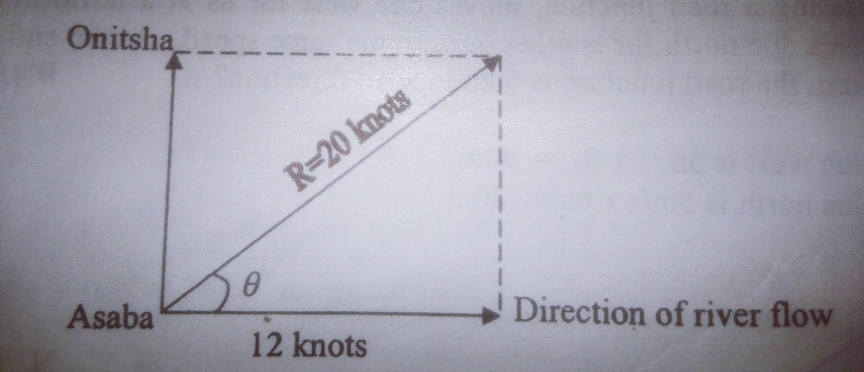
A tug boat is travelling from Asaba to Onitsha across the River Niger with a resultant
velocity of 20knots. If the river flows at 12 knots, the direction of motion of the boat relative to the
direction of water flow is?(Jamb)
Solution
$$ \text{To get direction } \Theta $$
$${Cos}\Theta = \frac{adj}{hyp} $$
$${Cos}\Theta = \frac{12}{20} $$
$$\Theta = {Cos^{-1}}\hspace{0.3em}{0.6} $$
$$\Theta = {53.13^\circ} $$
Example 5:
An aircraft attempts to fly due North at 100km/h. If the wind blows against it from east to west at
60km/h. its resultant velocity is?(Jamb)
Solution
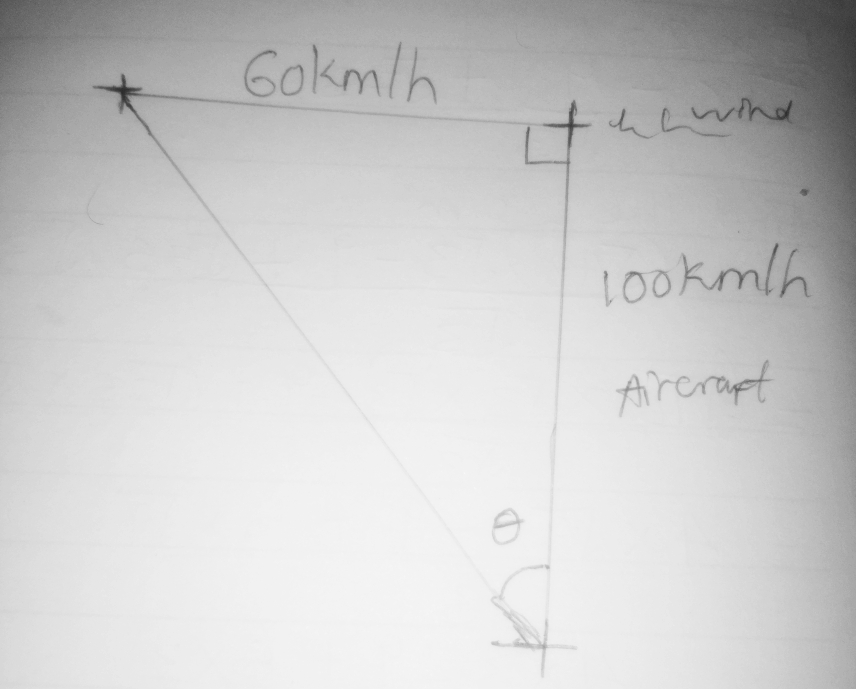
$$\text{resultant velocity is given by, } $$
$${V} = \sqrt{100² + 60²} $$
$$ {V} = \sqrt {13600} $$
$${V} = {116.62 \hspace{0.3em}km/h} $$
$$\text{the angle of direction is given as} $$
$$ {tan}\Theta = \frac{60}{100} $$
$$\Theta = {tan^{-1}}\hspace{0.2em}{0.6} $$
$$\Theta = {30.96} ≈ {31^\circ} $$
$$\text{Resultant vel. is 117 km/h }{N31^\circ}W $$