The position of a point in space is determined by its distance and direction from other points.
Position refers to the location of an object in space relative to a chosen reference point. It
is a fundamental concept in physics and can be described using coordinates such as distance, displacement, and
direction. Position is a key parameter when analyzing the motion of objects, as it allows us to track the changes
in an object's location over time and understand its spatial relationship to other objects or points in a system.
Frame of reference
A frame of reference is set of coordinate axes that determines the position of a body in two or three
dimensional space. The Cartesian coordinate is a basic frame of reference. It defines the position of a particle
in x,y and z coordinates.
Types of frame of reference
- Inertial Frame of Reference:
An inertial frame of reference is a frame in which an object at rest remains at rest, and an
object in uniform motion continues to move at a constant velocity in a straight line unless acted upon by an
external force. In other words, Newton's first law of motion holds true in inertial frames.
Examples:
- A car traveling at a constant speed on a straight highway is in an inertial frame of reference.
- An astronaut floating in deep space far from any massive objects, experiencing no gravitational or other
external forces, is in an inertial frame of reference.
- Non-Inertial Frame of Reference:
A non-inertial frame of reference is one in which objects don't follow Newton's first law of motion
without the presence of external forces. In such frames, objects may appear to accelerate even when no force is
applied to them.
Examples:
- A car making a sharp turn is in a non-inertial frame of reference because the passengers inside the car will
feel a force pushing them toward the side of the turn.
- An elevator accelerating upward or downward, causing a scale inside it to show a weight different from the
true weight of an object, is in a non-inertial frame of reference.
Distance
Distance can be defined as ths total path covered by a body in motion. It is simply the length between
two points. Distance is a scaler quantity hence it gives no information about direction. It is the
product of speed and time. Its S.I. unit is metres.
$$\text{distance} = {speed} × {time} $$
Worked Examples
Example 1: A car travels at an average speed of 100km/hr. What distance does it cover in 5 minutes?
Solution
$$\text{speed} = {100km/hr}$$
but since time is in minutes, convert speed to S.I unit which is m/s.
Since 1 minute = 60 seconds
then, 1 hour = 60 × 60 = 3600s
1km = 1000m
Hence,
$${speed} = \frac{100 × 1000}{3600} $$
$${speed} = 27.78m/s $$
time = 5 × 60 = 300s
$${distance} = 27.78 × 300 $$
$${distance} = \text{8334m or 8.3km} $$
Example 2: A driver traveling at a speed of 115km/hr received a text message on his mobile phone. How
far is he, in km, 20s later from when he received the text.
Solution
Speed = 115km/hr
time = 20s
Since speed is in km/hr convert time to hours
if 1hr = 3600s
then xhr = 20s
$$\text{therefore, x} = \frac{20}{3600} $$
$${x} = 0.00556hr $$
$$\text{distance} = {speed × time} $$
$${distance} = {115 × 0.00556} $$
$${distance} = {0.639km} $$
Worked Examples
Example 1: A man walks 1km due east and then 1km due north. His displacement is?
Solution
.jpeg)
The resultant vector is the distance from the starting point to the endpoint. It is represented by the
hypotenuse of a right angle triangle.
$${displacement} = \sqrt{opp² +adj²} $$
$$ {displacement} = \sqrt{1² + 1²} $$
$${displacement} = \sqrt{2}\text{ km} $$
A vector quantity is usually defined by its direction. To get the direction,
$${direction} = \Theta $$
Using trigonometric functions
$${tan}\Theta = \frac{opp}{adj} $$
$${tan}\Theta = \frac{1}{1} $$
$$\Theta = {tan^{-1}}\text{ 1} $$
$$\Theta = {45^\circ} $$
$$\text{Displacement is } \sqrt{2} \text{ km N}{45^\circ} \text{E} $$
Example 2: An aircraft travelled from calabar to kano as follows: it flew first to ilorin
convering a distance of 300km, 30⁰ west of North, and then flew 400km, 60⁰ East of North to kano. What
is the resultant displacement?
Solution
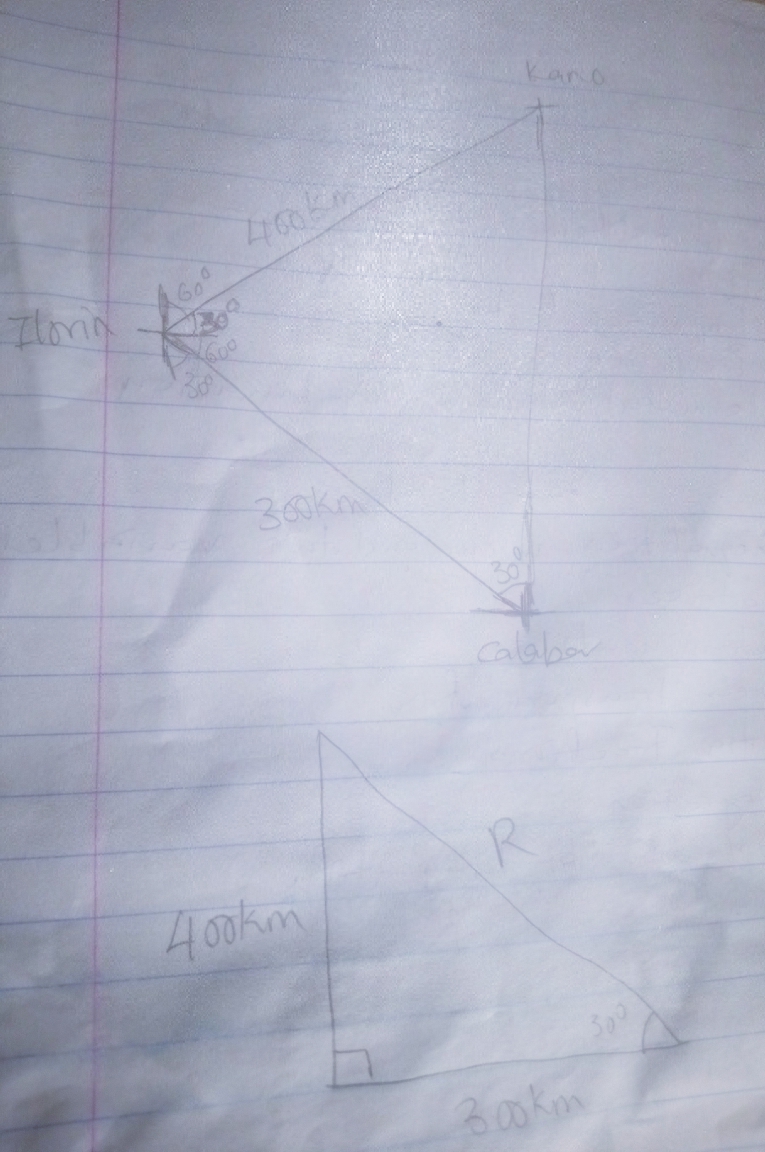
$${displacement} = \sqrt{300² + 400²} $$
$${displacement} = \sqrt{250000} $$
$$ {displacement} = 500km $$
The angle of the resultant velocity
$${tan}\Theta = \frac{300}{400} $$
$$\Theta = {tan^{-1}}{0.75} $$
$$\Theta = {36.87^\circ} $$
Example 3: A man walks 8km north and then 5km in a direction 60⁰ east of north. Find the distance
from his starting point
Solution
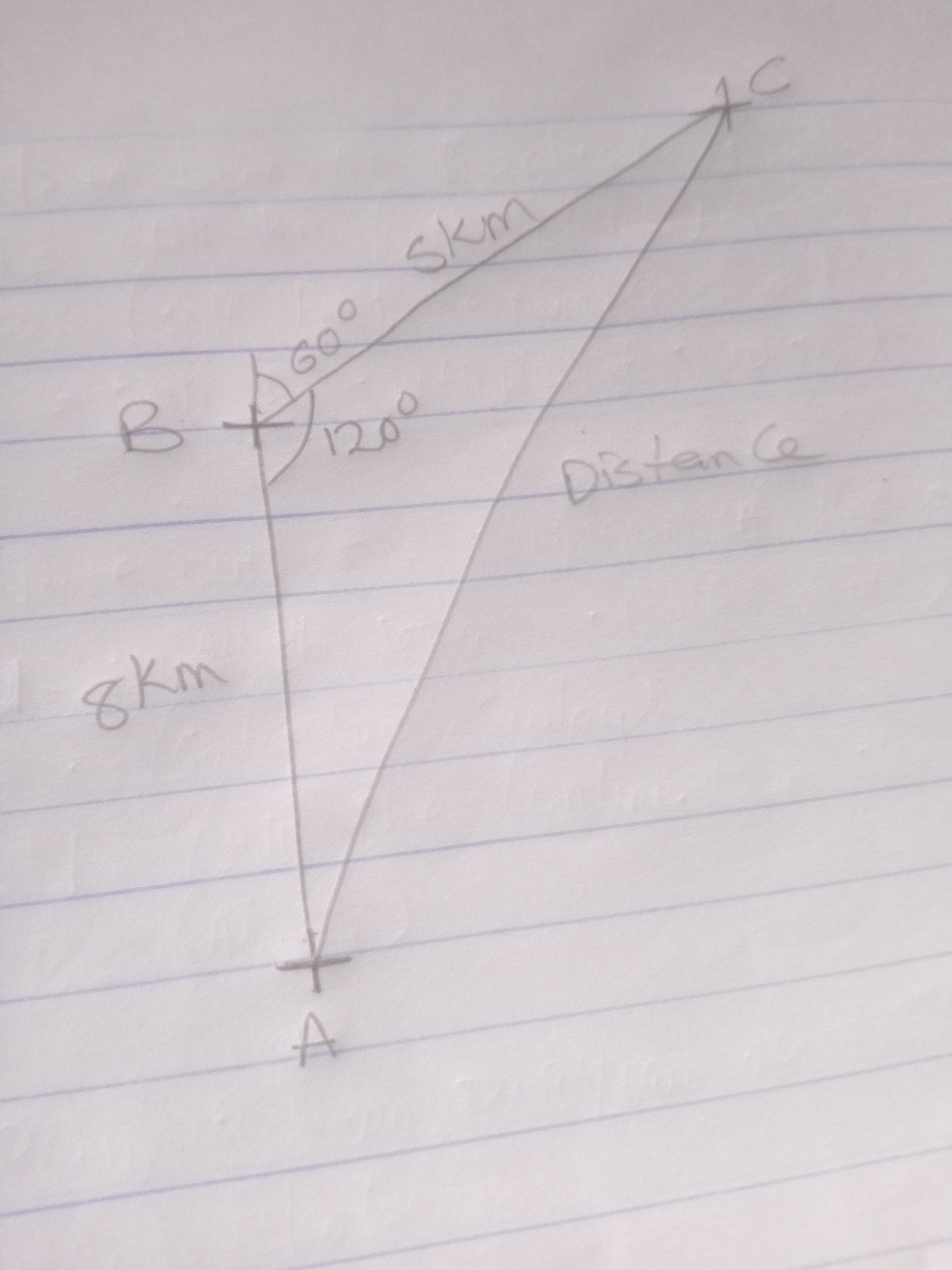
To determine the displacement when the velocities are not inclined at right angles, we use cosine to get
the displacement and sine rule to resolve the direction.
The displacement, R is given by
$${R} = \sqrt{a² + b² -2abcos\Theta} $$
where,
$$\Theta = \text{180 - angle given} $$
$$\Theta = {180 - 60} = {120^\circ} $$
$${R} = \sqrt{5² + 8² - (2 × 5 × 8 × cos 120)} $$
$${R} = \sqrt{25 + 64 - (-40) } $$
$${R} = \sqrt{129} $$
$${R} = 11.34km $$
To determine the direction, we use sine rule
$$\frac{R}{180- \text{angle given}} = \frac{a}{sin\Theta} $$
$$\frac{11.34}{sin120} = \frac{8}{sin\Theta} $$
Cross multiply
$${11.34}{sin\Theta} = {8sin120} $$
$${sin\Theta} = {0.611} $$
$$\Theta = {sin^{-1}}\hspace{0.1em}0.611 $$
$$\Theta = {37.66^\circ} $$
Distance between two points
The distance between two points placed on a Cartesian coordinate (x and y) can be determined by:
$${d} =\sqrt{({x_2}-{x_1})² + ({y_2}-{y_1})² } $$
Example 1: Find the distance between the points C(2, 2) and D(5, 6) (JAMB)
Solution
$${d} =\sqrt{({x_2}-{x_1})² + ({y_2}-{y_1})² } $$
$${d} =\sqrt{({5}-{2})² + ({6}-{2})² } $$
$${d} = \sqrt{3² + 4²} $$
$${d} = \sqrt{25} $$
$${d} = {5}\text{ units} $$
Example 2: Find the distance between the points (-2,-3) and (-2,4)
Solution
$${d} =\sqrt{({x_2}-{x_1})² + ({y_2}-{y_1})² } $$
$${d} =\sqrt{({-2}-{(-2)})² + ({4}-{(-3)})² } $$
$${d} =\sqrt{0 + 7² } $$
$${d} = \sqrt{49} $$
$${d} = 7m $$