The Arrhenius theory of rate of reaction states that for reactants to form products, the colliding particles (or molecules) of the reactants must possess a certain amount of energy so as to overcome the reaction barrier. This energy is the activation energy(Ea).
\[ k = A \ e^{-\frac{E_a}{RT}} \]
- k is the rate constant of the reaction.
- A is the pre-exponential factor (frequency factor).
- Ea is the activation energy.
- R is the gas constant.
- T is the absolute temperature in Kelvin.
According to this equation, the rate constant k depends on the temperature T and the activation energy Ea. It shows how increasing the temperature can increase the rate of a chemical reaction.
Rate law
The rate law in chemistry is a mathematical expression that describes the rate of a chemical reaction. It shows the relationship between rate of reaction and concentration. It is typically represented as:
Rate = k[A]x[B]y
Where:
- Rate: Represents the reaction rate.
- k: Is the rate constant, specific to the reaction and dependent on factors like temperature.
- [A] and [B]: Denote the concentrations of the reactants A and B.
- x and y: Are the reaction orders, determined experimentally, showing how concentration affects the rate.
The reaction rate is directly proportional to [A]x and [B]y, and the values of x and y tell us how the concentrations influence the rate.
The sum of the exponents x and y gives the overall order of the reaction.
Examples
Example 1: If the reaction is second order with respect to A (x = 2) and first order with respect to B (y = 1), and the rate constant k is found to be 0.05 M-1s-1, calculate the rate of the reaction when [A] = 0.2 M and [B] = 0.1 M.
Solution
The rate law is given as:
Rate = k[A]x[B]y
Substitute the given values:
Rate = (0.05)(0.2)2(0.1)1
Calculating:
Rate = 0.0002 M-1s-1
So, the rate of the reaction when [A] = 0.2 M and [B] = 0.1 M is 0.0002 M-1s-1.
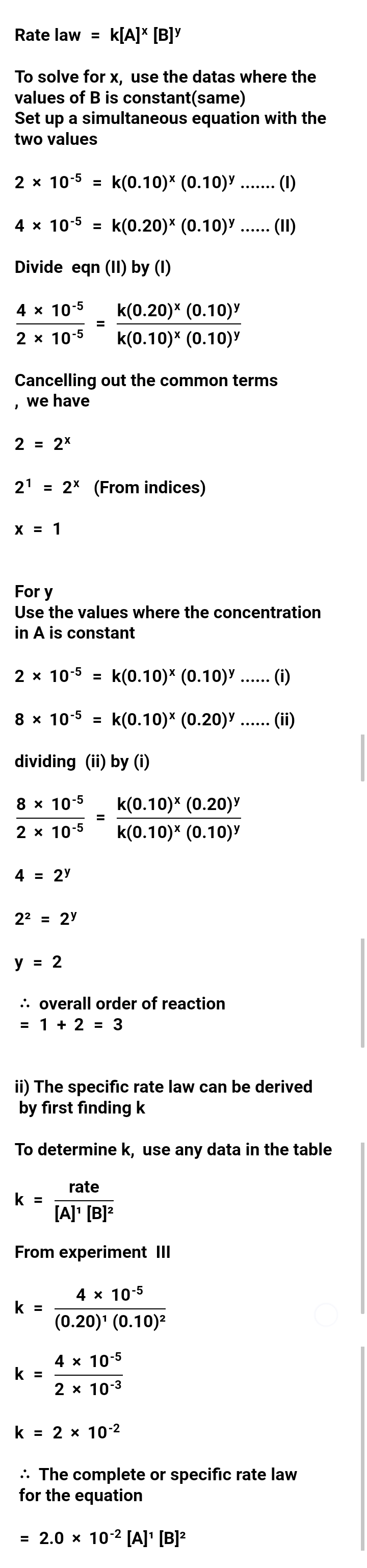
Example 2: A kinetic study of the reaction
A + B = C
was carried out at different concentrations of
the reactants at 25⁰c. The results obtained are summarized in the table below
| No | [A] moldm-3 |
[B] mol/dm³ | Reaction rate MS-1 |
| I | 0.10 | 0.10 | 2 × 10 -5 |
| II | 0.10 | 0.20 | 8 × 10⁻⁵ |
| III | 0.20 | 0.10 | 4 × 10⁻⁵ |
Determine
- The overall order of the reaction
- The specific rate law of the equation